Three things we wrote this summer, and the thread that runs through them

The Summer 2026 issue of Dædalus, guest edited by the cochairs of the Our Common Purpose commission, surveys the efforts underway to renovate U.S. democracy. Six years after the report’s publication, which strategies gained momentum? Which have fallen short?
The local news field keeps asking what comes after the collapse. This summer the two of us answered that question in three different forums: a 250th-anniversary issue of Daedalus on renovating American democracy, a report-back on a futuring project with 175 field leaders in four states, and a long-form interview about what happens when journalism stops being a profession and starts being a civic skill again.
Read together, they make one argument. Civic information is a public good. The people already meeting community information needs are the field's biggest asset. And the way to a better 2036 runs through shared outcomes, not through any single institution's survival.
Here’s what each piece says, and why we see them as a single thread:
The case for a common cause: “Civic media in the second Gilded Age”
(Darryl, in Daedalus)
Public media isn’t the only public good on the chopping block. Vaccination programs, public education, emergency services, subsidized housing, public transportation — they’re all services people should have access to based on benefit rather than ability or willingness to pay, and each is being defunded or dismantled by the same concentration of wealth and power that threatens local news. That’s the argument at the center of Darryl's essay for the Summer 2026 issue of Daedalus, the journal of the American Academy of Arts and Sciences, which asked contributors how to renovate American democracy in its 250th year.
The essay's opening premise is that platform monopolies have concentrated control over civic discourse at a level not seen since the first Gilded Age. But if civic information is a public good like the others, then the people defending public health, public schools, and public transit are natural allies of the people defending public media, and vice versa. A public media system that informs, engages, and equips Americans to protect these pillars of civic life isn’t competing with those sectors for scarce dollars. It’s the infrastructure they all need to make their case.
The essay grounds that in what already exists. It names the practitioners building locally governed, human-scaled information systems now, including the Documenters Network, CivicLex, Documented, the Department of Public Transformation, The 51st, and describes what they share as local stewardship: community-scale governance of information and connection, where relationships matter more than metrics. It endorses relational technology, tools built for collective benefit at a 1-10-100 scale, where the moderation problems that are unworkable for platforms become manageable. And it puts the funding burden where a public good's burden belongs: on public investment and democratic governance, not on entrepreneurial hustle.
We think the common-cause argument is the piece of the essay the field hasn’t yet picked up. The coalitions that will win public financing for civic information are not going to be made of journalists alone — it’ll take a cross-sector village of community information stewards.
What Local News 2036 taught us
(Anika, on the Commoner blog)
Instead of reacting to the next funding gap or legislative deadline, what if the field stepped back and asked what it actually wants 2036 to look like?
That question drove Local News 2036, which we built with Press Forward, Democracy Fund, and Dot Connector Studio. The project developed three scenarios for the next decade of local news, then turned them into a facilitation toolkit that people could run themselves. Four state coalitions did: Vermont, New Mexico, Washington, and Montana.
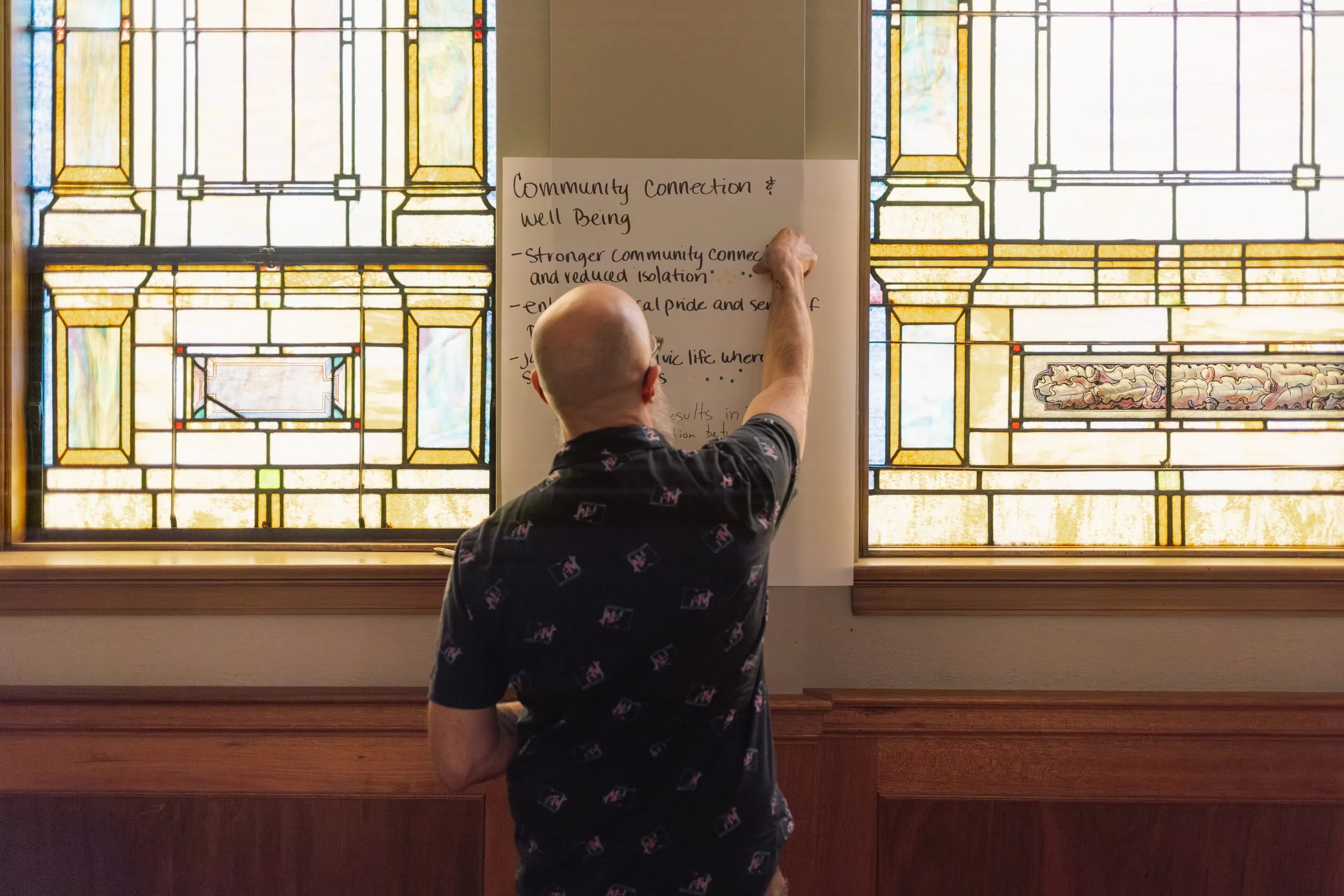
The Washington News Fund and Washington State News Alliance hosted a gathering in Yakima, WA, using the Local News 2036 guide to ask participants which community outcomes they most want the coalition's work to support. (Photo by Jake Parrish)
To us, the finding that matters most is how consistent the priorities were across very different rooms. Media literacy as a core civic skill in K–12, information equity across communities, government accountability, and civic participation kept surfacing. Coalitions that came in with different politics, geographies, and organizational mixes landed in roughly the same place once they were asked to describe an outcome instead of defending a model.
Anika's post makes a bigger claim from that pattern. As the field debates what a reimagined public media system should look like after the CPB rescission, LN2036 offers a way to build that definition collectively, from the ground up, rather than leaving it to a small group of institutions. Seventeen Press Forward chapters have expressed interest in running the process — and the toolkit we built is available to anyone who wants to try it.
Re-blurring the lines between journalism and civic life
(Darryl, with Sam Pressler in Connective Tissue)
Journalism skills are civic skills. That’s the thread through Darryl's conversation with Sam Pressler for Connective Tissue, Sam's newsletter on civic infrastructure and the practical work of holding communities together.
The interview covers how journalism professionalized itself away from the public through pricey degrees, online paywalls, and pernicious gatekeeping, and what it looks like to reverse that: Participatory, local-first networks like Documenters, News Futures as a membership network of individuals rather than institutions, and funding for practitioners who work at the 1-10-100 scale. It also gets into how we think about support organizations themselves. Darryl talks about compostable organizations, institutions designed to release their assets back to the community at peak effectiveness instead of managing a slow decline, and about operating News Futures on a do-ocractic logic where the work belongs to the people who step up to do it.
If the Daedalus essay is the policy argument and the LN2036 post is the field evidence, this one is the practitioner's account of how it feels from the inside.
What the three pieces add up to
Put them side by side and the shape of our work is clear. We write the argument for civic information as public infrastructure. We build and run the processes that let a field decide together what it wants. And we stay close to the practitioners doing the work at human scale, because that’s where the field's real assets are.
That’s also the work we want to keep doing in 2027. If you’re a philanthropic leader thinking about how to align a portfolio or a state coalition around shared outcomes, a support organization designing a program for practitioners, or a local government trying to figure out what your community needs from you next, we want to talk.
And if you know someone who should be reading this, forward it. This list grows one introduction at a time, and we’re grateful for each one.